
The BJP-led NDA has won 16 out of the 28 Legislative Council seats for which elections were held in four states. The ruling alliance won all four seats in Karnataka, six out of 11 in Uttar Pradesh, four out of eight in Bihar, and two of five in Maharashtra.
Unlike elections for Members of the Legislative Assembly (MLAs), not every adult citizen is eligible to vote for Members of the Legislative Councils (MLCs). Not all states have Legislative Councils, either.
Here’s how such elections are held, why they use ballot papers, and why there are specific ‘teacher’ and ‘graduate’ constituencies.
A second chamber for states
India’s legislatures are divided into two categories — unicameral [single House] or bicameral [two Houses]. The Constitution mandates a bicameral legislature (Lok Sabha and Rajya Sabha) at the national level and gives states the option of having a second chamber called the Legislative Council.
During the framing of the Constitution, there was disagreement in the Constituent Assembly on having a second chamber in states. The arguments in support of a second chamber were that it would bring different viewpoints, be the voice of reason and check hasty action by the popularly elected House.
The opposing viewpoint was that having a second chamber would be costly, delay government action and political leaders would use its membership for dispensing political favours.
Our Constitution framers resolved these differences by giving states the power to decide whether they wanted a second chamber, capped the size of the House and put limits on its powers. And in doing so, they created a unique legislative institution.
Currently, six states — Andhra Pradesh, Bihar, Maharashtra, Karnataka, Uttar Pradesh and Telangana — have a Legislative Council.
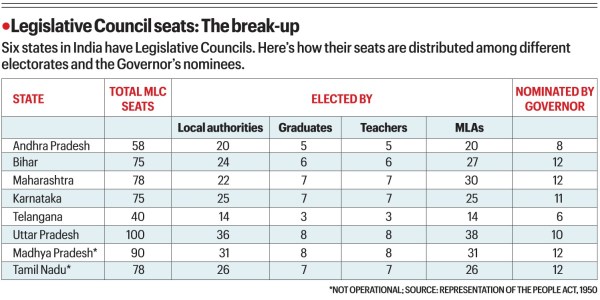
States with Legislative Council in India.
Article 171 specifies that a Legislative Council in a state will have a minimum of 40 members (MLCs), and pegs the maximum number to a third of the size of the Legislative Assembly.
The Constitution also specifies the membership structure of the state Legislative Councils.
MLAs elect one-third of the Council’s members, local body members elect another third, graduates elect one-twelveth, teachers elect another one-twelveth, and the Governor nominates the remaining MLCs. The Representation of People Act, 1950 provides the membership breakup of every Legislative Council in the country.
The voting process for MLC elections
MLCs have a six-year term and a third of a Council’s members retire every two years. To contest an MLC election, an individual should be at least 30 years old and be an elector in the state. Governors can nominate individuals from the fields of literature, science, art, co-operative movement and social service who are residents of the state.
Elections for MLC seats in which MLAs are the voters are straightforward. Only those individuals who are current members of the Legislative Assembly get to vote in the election.
But the other three categories of MLCs — local body, graduate and teacher — are all territorial constituencies. So local body members, graduates and teachers of those areas in the state get to vote in the election.
For local body MLC constituencies, only current members of those bodies can vote.
The electoral roll for graduate and teacher constituencies has different requirements. These rolls are prepared fresh before every election and even existing voters have to apply again to get on the roll. They also have to fulfil the specified criterion from the qualifying date, which is November 1 every year.
In the case of graduate constituencies, the voter should be a citizen, ordinarily a resident in the constituency and for three years holding a graduate degree from anywhere in India.
In case of teacher constituencies, the voter should, in the last six years, have been a teacher in an educational institution (not lower than a secondary school) for at least three years.
Graduate and teacher constituencies
Here, a question arises. What’s the rationale for an electorate representing specific sections of society (in this case, graduates and teachers)?
The practice of lawmakers representing specific sections of society began in pre-independent India. The Government of India Act of 1935 provided for representation based on religious, economic and social grounds.
Constituent Assembly Member Shibban Lal Saxena suggested that the Council should represent the intelligentsia of a province. He suggested that some members should be elected by different subsets of the entire electorate. A subset could be graduates, members of trade unions, local body members, learned professionals, and more. This idea was then incorporated into the Constitution.
Preferential choice
Voting in a general election is simple — a voter casts their vote for one candidate. The simplicity of this voting process allows an electronic voting machine to be used in the election.
But voting in an MLC election is done through a single, transferable vote. This method requires a voter to rank the contesting candidates by indicating their preference (just like in a Rajya Sabha election).
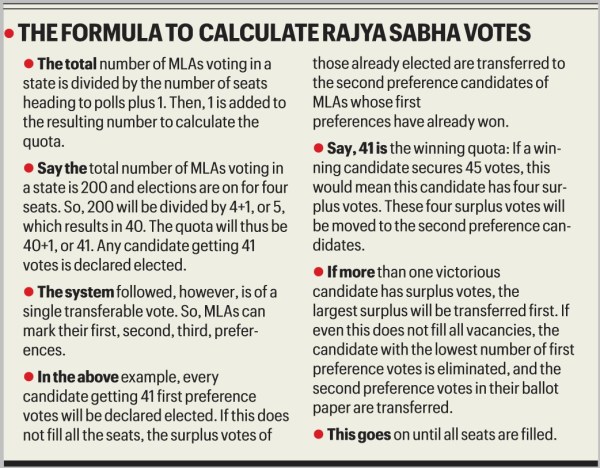
Rajya Sabha voting formula.
A ballot paper contains the names of the contesting candidates (besides NOTA). The voter is then required to indicate their preference by writing 1,2 or 3 in front of the candidate’s name. At the time of counting of votes, candidates get eliminated if they don’t get the required number of votes meeting a threshold.
There is an additional niggle when it comes to MLC elections. In Rajya Sabha elections, the voting MLAs have to show their votes to their party’s election agent. Parliament introduced this open voting system in 2003. However, when MLAs vote in an MLC election, their vote is secret and there is no requirement to show the vote to a candidate’s election agent.
How Councils compare with Rajya Sabha
For all the din and drama associated with Legislative Council elections, these bodies are not comparable to Rajya Sabha. The Upper House is a continuous body; however, the existence of a Legislative Council depends on the Legislative Assembly. Our Constitution gives Assemblies the power to recommend the creation and abolition of a Council. These bodies also don’t have the same legislative teeth as Rajya Sabha. They don’t have the Constitutional mandate to give shape to legislation passed by the Legislative Assembly.
In 2013, a Parliamentary Committee scrutinising the creation of a new Legislative Council in Rajasthan had observed that “there is a need to evolve a national policy conscientious with regard to creation/abolition of Legislative Council particularly in regard to the fact that the status of Second Chamber cannot be of temporary in nature depending on the mood of the Government of the day nor can be abolished once created, only at the whims and fancy of a newly elected Government in the State”.
The writers work at PRS Legislative Research.